
Q1 2026 Review
Investors have had a volatile start to 2026, as markets have been affected by multiple cross currents. Despite this volatility however, overall, markets have been quite resilient.
Mega-cap technology companies came under increased scrutiny to end 2025, and have been highly sensitive to geo-political events to start 2026. The US administration implemented a flat 10% tariff on all imports. Middle East tensions rose significantly, impacting oil and gas supply and pushing prices higher. Stocks and bonds sold off as markets focused more on upside inflation risks than downside risks to growth. Gold and emerging markets stocks fell while the US dollar rallied.
The MSCI Europe ex-UK Index fell 2.3% as elevated geopolitical tensions rattled the European market. The sharp increase in European gas prices was not to the levels seen in 2022, but still generated concerns about Europe’s growth outlook. While the UK economy is also exposed, the FTSE All-Share delivered positive returns of 2.4%, supported by its commodity tilt. A weaker sterling provided an additional tailwind for UK stocks.
Emerging market equities came under pressure later in the quarter as risk-off sentiment prevailed and markets evaluated Asia’s exposure to energy exports (more than 80% of global oil and gas that flows through the Strait of Hormuz is destined for Asia). The MSCI Asia ex-Japan Index was down 1.1% in the first quarter.
The S&P 500 Index was down 4.3% in the first quarter. Tech stocks had a challenging start to 2026 as investors grew concerned that new AI capabilities would threaten the software as a service (SaaS) model.
While there is a high degree of uncertainty around how the conflict in the Middle East will evolve, the base case is that of a de-escalation in the near term, given there are strong incentives for this to happen for many of the key players and upcoming events. These are namely:
- The US president does not want an ongoing war during his rescheduled visit to China on May 14, nor rising gasoline prices and a falling stock market while heading into the midterm elections.
- Israel will comply with US requests to de-escalate in the short term, prioritizing the US relationship and recognizing the limits of an air-only campaign.
- China and other Asian counterparts will pressure Iran to de-escalate once the US suspends its strikes, both due to potential problems with their own energy supply and fear of a western recession that could weaken China’s already stagnant economy.
- Iran, having demonstrated its ability to disrupt global activity, has sufficiently reduced the likelihood of another attack in the short term.
Three Likely Scenarios in the Middle East
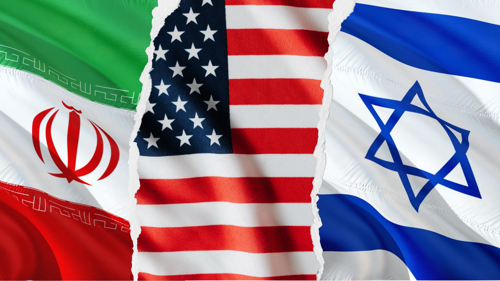
As it can be difficult to place too much weight on rational reasons we think conflict should be short lived, let's look at three possible scenarios in more detail, and the effects each could have on global markets and economies.
1. De-Escalation: The best outcome of the three is a quick and effective de-escalation of the conflict. In the de-escalation scenario where the Strait of Hormuz reopens within a relatively short timeframe and oil falls towards $70-80 per barrel, global economies are likely able to take the disruption in their stride.
The impact on US headline inflation is expected to be muted, with an increase of roughly +0.2% for the year-end estimate. The UK and eurozone could experience a bigger inflation impact (closer to a +1% increase for year-end inflation), which would upend the disinflationary process. Gas prices in the UK and eurozone would be globally oriented and tied to global LNG prices.
The growth impact in this scenario is likely to be limited, albeit worse for the more energy import-dependent economies of the UK and eurozone than in the US. However, the eurozone’s positive economic momentum could continue to be aided by the impact of German fiscal spending and deregulation more broadly in the eurozone.
2. Partial De-Escalation: In the partial de-escalation scenario, the conflict continues longer, and flows through the Strait of Hormuz can only partially restart due to lingering risks and uncertainty. Oil continues to trade near $100 per barrel and the resulting energy shock leads to a more adverse effect for the UK and eurozone vs. the US.
Year-end inflation in the UK and eurozone could be around +2% higher, mostly driven by energy prices, but in this scenario core prices, as well as food prices, will continue to increase. Such a rise in prices are likely to hit consumer purchasing power, corporate margins and sentiment, causing growth to slow, although the hit to disposable income remains much less than that experienced in 2022.
The growth hit in the US would be limited as the hit to consumers’ purchasing power is largely offset by higher revenues from energy exports (shale oil and LNG). The purchasing power effect would be more immediate and a drag on the economy, but trend-growth would still be attainable given fiscal spending from the One Big Beautiful Bill taking effect in 2026.
3. Escalation: The worst of the three scenarios.
In the escalation scenario where oil prices potentially spike to over $150 per barrel, the UK and the eurozone are likely to experience a recession. Inflation at year-end could be +3-3.5% higher due to the conflict.
In terms of inflation, the US is likely to remain more insulated (+1% higher inflation), and the growth risks are more limited, particularly if the Administration once again looks to tax cuts to win support ahead of the midterms.
Should the global economy tumble into recession, in Europe at least, it is unlikely that government support packages of anywhere near the magnitude seen in the last crisis (Covid-19) are provided. While this means household income and consumption will take the hit in the short term, it also reduces the chance of inflation getting embedded and central banks having to hike rates. The private sector is in reasonably good shape to absorb the shock and the world economy was experiencing decent momentum overall when looking at GDP growth and earnings growth prior to the Iran conflict. Household and corporate balance sheets were strong following over a decade of deleveraging and, on aggregate at least, European households are still sitting on sizeable savings buffers accumulated during and after the Covid-19 pandemic.